
Addressing the BRICS investment seminar in Mumbai ahead of the 5-nation Summit in Goa on October 15-16, Jaitley said the government has put FDI on automatic route in almost 90 per cent of the areas that are eligible for foreign direct capital.

India insisted that PM Modi and Chinese President Xi Jinping held "conversation on range of issues" in Hamburg.

The readouts by the Indian and Chinese sides on the meeting on Monday between External Affairs Minister Sushma Swaraj and her Chinese counterpart Wang Yi in Moscow bring out that divergences are crowding into the centrestage of their relationship, says Ambassador M K Bhadrakumar.
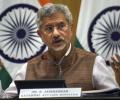
The external affairs minister also made it clear that with Pakistan, the issue is not Article 370, the issue is cross-border terrorism and the first thing that has to come to table for any talks with Pakistan has to be the terrorism issue.

Modi was expected to arrive in Wuhan in the evening on April 26 and join Xi in the informal summit at a picturesque location the next day.
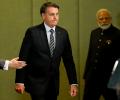
As someone with nostalgia for the good cheer and friendly feelings of Brazilian people, former Ambassador to Brazil B S Prakash can only hope that when they see on their TV screens their President being feted on Rajpath, they will sense India's goodwill for Brazil.

Jaishankar is the first foreign secretary to head the Ministry of External Affairs as minister.

May emphasise that the country is back on the fiscal consolidation path by reining in fiscal deficit at 5.2%.
Foreign residents increased their holdings of long-term US securities in May; net purchases were $34.6 billion.

'While China expressed reservations on the Indian role in the South China Sea, Beijing threw to the winds Indian concerns on Kashmir by announcing $46 billion in investments Pakistan occupied Kashmir,' says Srikanth Kondapalli.

Both sides "positively assessed" India-Myanmar security cooperation in the backdrop of certain insurgent groups from northeastern Indian states.

Ahead of the first meeting between Prime Minister Manmohan Singh and Chinese President Xi Jinping in Durban, China today said such a meeting will help to build mutual trust and cooperation between the two countries.

Seeking to build on the "great cooperation potential" between India and China, President Hu Jintao has told Prime Minister Manmohan Singh that it is Beijing's "unswerving policy" to develop bilateral ties and deepen strategic cooperation.
Sounding upbeat over the resumption of defence exchanges with India, China on Thursday said it was 'vigorously committed' to developing military ties with its 'important neighbour' and was ready to resolve the visa row through friendly consultation.

He just finished his first foreign visit as prime minister and now PM Narendra Modi has has been invited to witness the final of the World Cup football currently being held in Brazil.

Prime Minister Narendra Modi leaves for Brazil on Sunday for attending the five-nation summit of BRICS nations on July 14 and 15 which is expected to finalise the setting up of a development bank and seek reforms of the United Nations and international financial organisations.

Narendra Modi will be travelling to Israel, the first by an Indian prime minister to the Jewish country with which bilateral defence cooperation is on an upswing.

"The basic idea is that India would like to continue to be the most beautiful woman wooed by all men, notably the two strongest in the house, US and China," the article titled 'Indo-US strategic distrust stalls LSA signing'.

Top Indian and Chinese officials on Tuesday finalised President Xi Jinping's maiden visit to India, including the programme and key issues to be discussed, amid indications that he may begin his tour in Prime Minister Narendra Modi's home state of Gujarat on September 16.
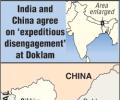
'While overall this is a face saving deal just before the BRICS meeting in Xiamen, any forward military movement at Doklam once again could bring the two Asian giants at loggerheads,' says China expert Srikanth Kondapalli.

The time is ripe to extend the confrontation with the Chinese to the maritime domain, says former RA&W officer Krishan Varma.
Apart from emphasising the importance of India's economic development, and its re-integration into the global economy, Dr Singh has repeatedly emphasised the importance of the ideas that define the Indian civilization and the Indian Republic for global peace, security and challenges, ranging from terrorism to pandemics.
Leaving for Russia on his first foreign visit after assuming office for a second term, Prime Minister Manmohan Singh said on Monday India is ready to play its part in coordinating global efforts to overcome the economic slowdown. Singh, who will be attending the Brazil-Russia-India-China and Shanghai Cooperation Organisation Summits, said the BRIC grouping has the potential to lead global economic growth.

With Donald Trump unable to make it, Modi settles for Brazilian President Jair Bolsonaro.

China, however, remained ambiguous about the status of its own troops.
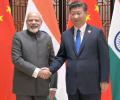
The Chinese and the Indian troops were engaged in a standoff for 73 days in Doklam.

As Xi is due to arrive in Goa on Saturday to take part in the BRICS Summit, Chinese foreign ministry spokesperson Geng Shuang said the relations between India and China made "great headway" despite some "disputes" but there was no change in in Beijing's stand on the issues of NSG and Azhar.
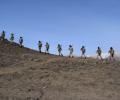
Sources also asserted that there was a "status quo" at the Dokalam for past six weeks.
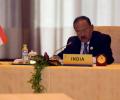
The Foreign Ministry also posted a 15-page fact sheet with maps and other details about the standoff since it began on June 16.
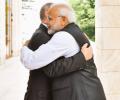
Modi said India and Russia have been friends for a long time and thanked Putin for inviting him for the first-ever informal meeting at Sochi.

'One lesson to emerge out of the Modi-Putin summit is that India can be more self-confident that it possesses inherent strengths to leverage its interlocutors to influence Pakistani policies,' says Ambassador M K Bhadrakumar.

'If an 'informal meeting' with Xi Jinping materialises before the SCO summit in June, that itself could be regarded as a significant breakthrough in India-China relations,' says Ambassador M K Bhadrakumar.

India and Brazil on Wednesday called for urgent progress in reforms of the UN Security Council, as they agreed to scale up bilateral ties and deepen cooperation in international fora.

The government on Wednesday said there was no threat to Air Force One, the aircraft that flew Prime Minister Narendra Modi back from Germany over the airspace where Malaysian Airlines plane was shot down on Thursday.

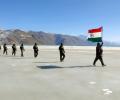
India has told China not to "shift goalposts" and "confuse" managing the border affairs and restoring peace at the frontiers with the larger issue of the resolution of the boundary question, which is dealt with by different designated mechanisms.

China's intended role for AIIB is not so different from the existing Western lenders like the World Bank.
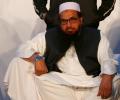
The perpetrators of the 2008 Mumbai attack, who shot dead 166 people, had confessed to details that should have been enough to hang him, but Pakistan enjoyed his anti-India rhetoric and let him spread his tentacles. A revealing excerpt from Khaled Ahmed's Pakistan's Terror Conundrum.

The meeting, which comes after the Doklam standoff, is aimed at a working a new paradigm for the bilateral relations for the next 15 years.

'It is astonishing that such a serious issue be handled in so casual and cavalier a fashion, but this has become what is expected of this government,' observes Aakar Patel.
 © 2026 Rediff.com - Advertise with us - Disclaimer - Privacy Policy - Sitemap - Feedback - About us - Terms of use - Grievances